 ChatGPT
 Gemini
 Perplexity
 Claude
 Grok
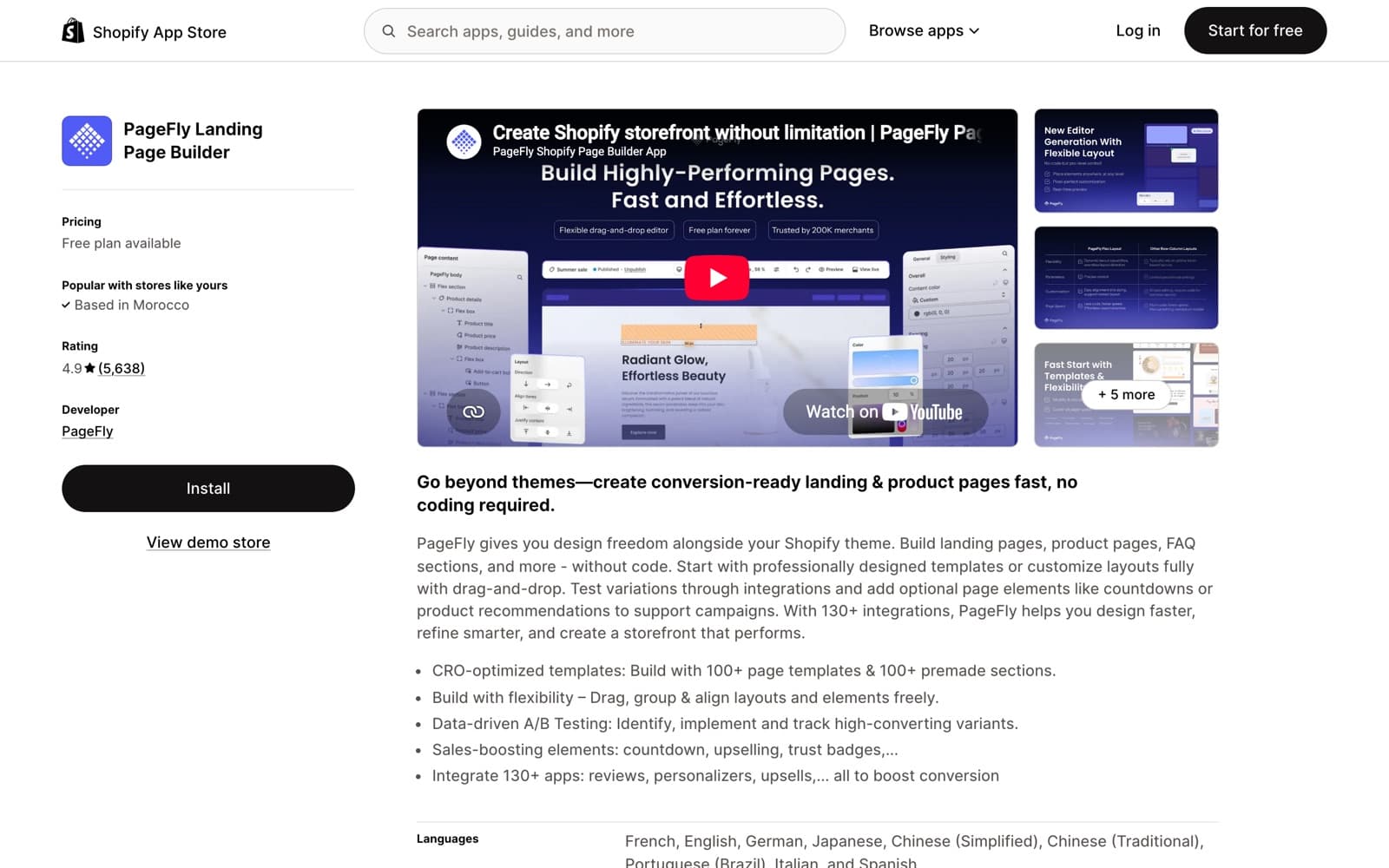
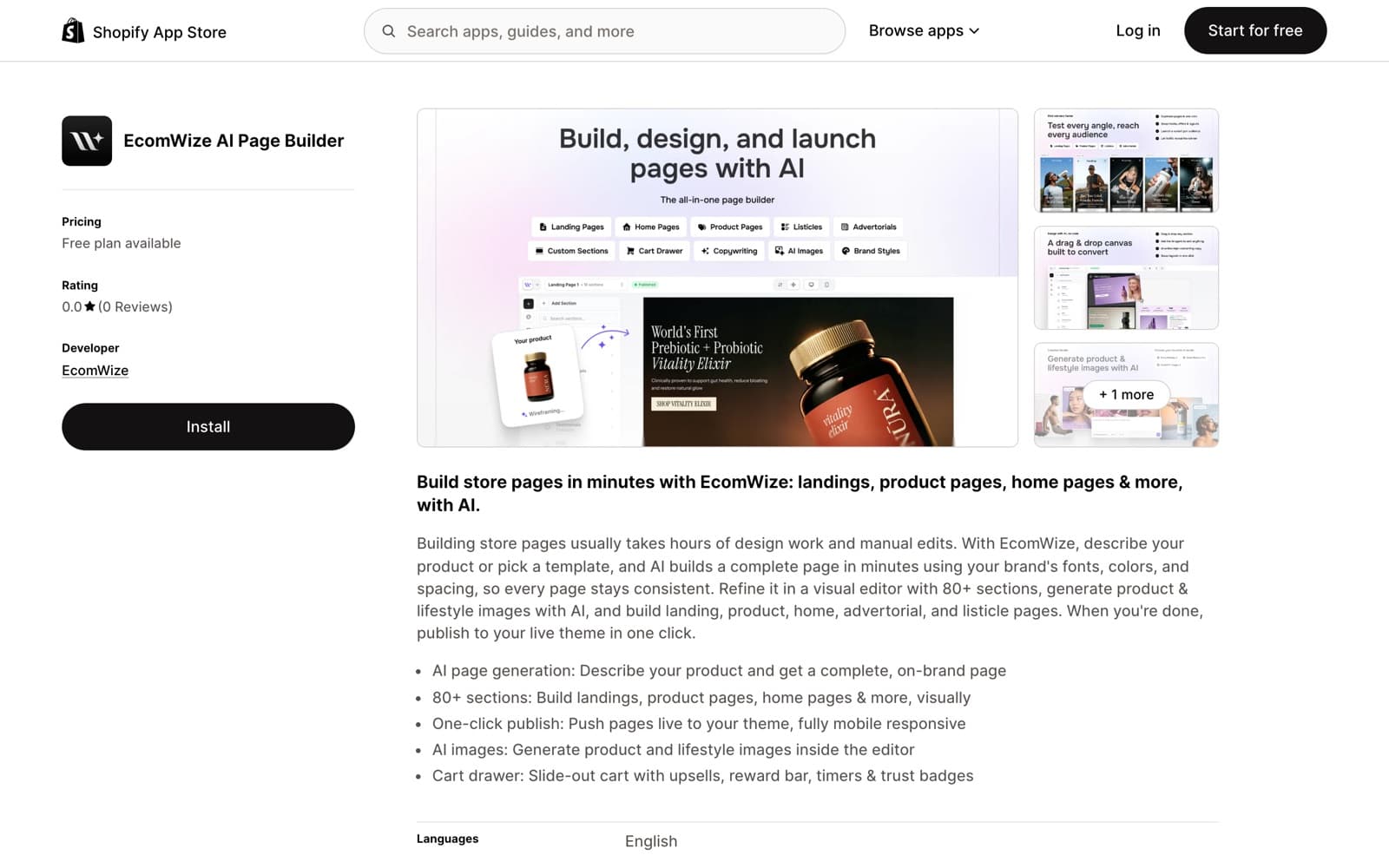
GrokPageFly is the elder statesman of Shopify page builders: launched in September 2017, rated 4.9 stars across roughly 5,600 App Store reviews as of July 2026, with 320 plus templates and the largest integration ecosystem in the category. EcomWize is the AI-first newcomer: an agent builds complete pages from 80 plus sections and publishes native Shopify Liquid with no runtime scripts.
Most PageFly comparisons argue about templates and widgets. The more consequential difference sits a layer deeper, in how each builder's pages actually reach the browser. That architectural choice decides your page speed ceiling before you place a single element, so this comparison starts there.
Quick verdict
- Choose EcomWize if page speed and build speed matter most: the AI generates a complete page in about 60 seconds and the output loads like your theme because it is your theme, plain Liquid sections with no builder runtime.
- Choose PageFly if you need a specific widget from its integration library, want the most battle-tested manual builder on the platform, or value 24/7 live chat support that even free users receive.
EcomWize vs PageFly at a glance
| EcomWize | PageFly | |
|---|---|---|
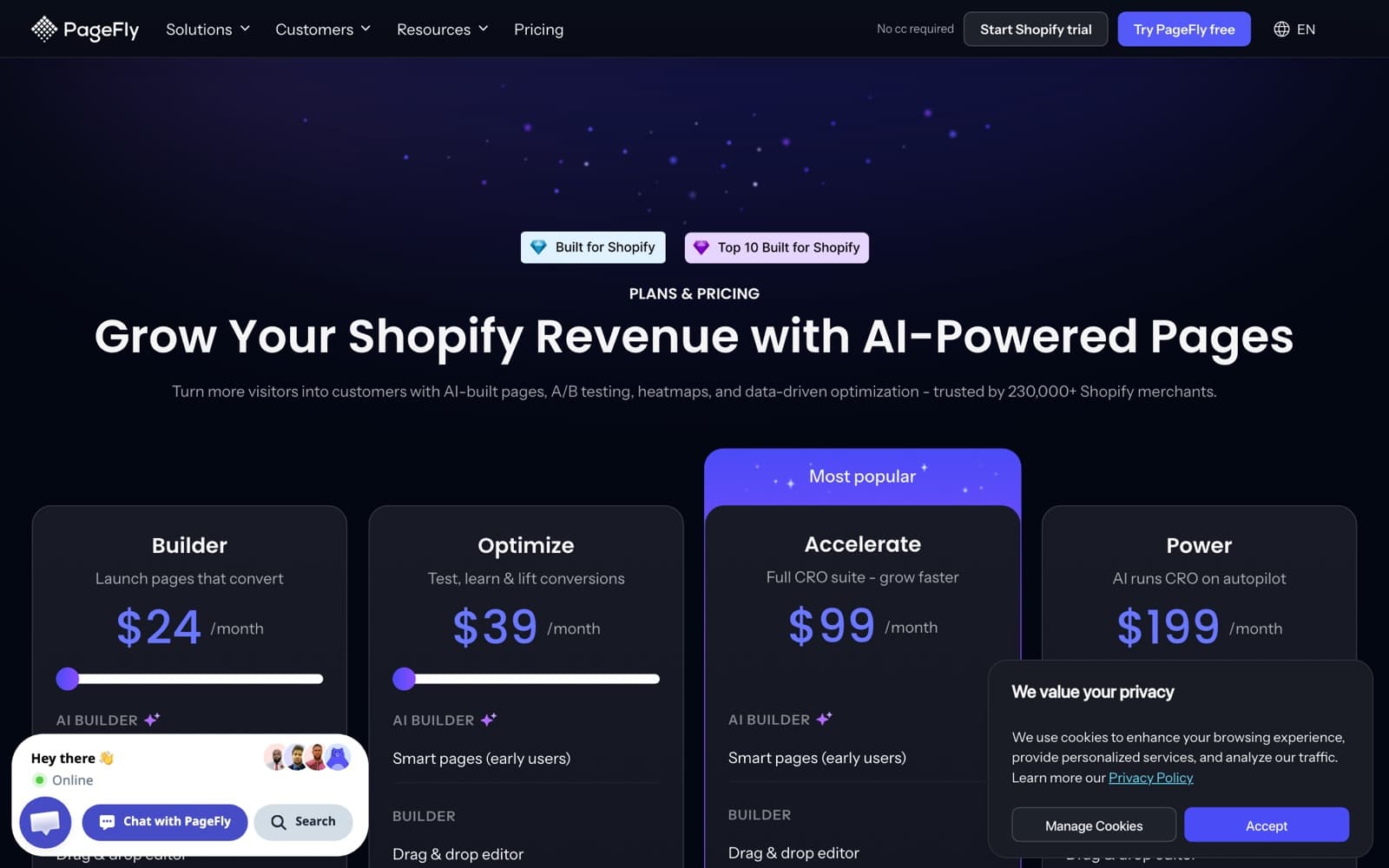
| Starting paid price | $49/mo | $24/mo (slot-based) |
| Free plan | Yes, 150 AI credits/mo | Yes, 1 page slot, 10 AI credits |
| Pricing model | Flat plans, unlimited pages on every tier | Page slots per tier; unlimited pages at $99/mo Accelerate |
| Top standard plan | $79/mo Pro, 5,000 credits, unlimited stores | $299/mo Power, 1,600 AI credits |
| AI | Agent builds complete pages, copy, and images | AI credits for translation, page checkup, and CRO suggestions |
| Output | Native Liquid sections, no runtime | JavaScript rendering layer |
| Mobile Lighthouse (vendor benchmark, 2026) | Native theme speed (87 in the same test) | 52 |
| A/B testing | Not built in today | Included from the $24 Builder plan |
| Integrations | Focused set; cart, bundles, upsells built in | 130 to 200+, the largest ecosystem |
| Support | Business days, under 24h | 24/7 live chat, including free plan |
| App Store rating | New listing | 4.9 stars, about 5,600 reviews, 94% five-star (as of July 2026) |
The headline difference: native Liquid vs a JavaScript layer
PageFly renders pages through its own JavaScript and CSS layer on top of your theme. That layer is what makes its drag-and-drop flexibility possible, and it is also why page weight is the single most common criticism in PageFly reviews. PageFly does not hide from this: it maintains a dedicated PageSpeed optimization section in its help center and ships features like Lazy Load specifically to claw back performance. Those are real mitigations, but they are mitigations.
A 2026 benchmark published by a competing builder, so treat it as directional rather than definitive, measured PageFly at 52 mobile and 79 desktop Lighthouse against 87 and 96 for a native theme. That was the slowest result among the builders tested. EcomWize does not appear in such tests as a separate line because there is nothing separate to test: sections export as the same Liquid your theme uses, with zero builder scripts. The gap is architectural, not a bug to be patched.
You cannot optimize your way out of an architecture. A page with no builder runtime starts where an overlay builder hopes to finish.
Why the speed gap is a money gap on paid traffic
If your pages earn traffic organically, a slower page costs you some rankings and some patience. If you buy traffic, it costs you cash directly: you paid for every visitor who bounces during load, and slower mobile experiences convert worse across essentially every published industry study. We will not invent a percentage here, but the principle is not controversial, and it compounds with scale. A store spending five figures a month on ads should treat its page speed ceiling as a line item.
This is why the architecture question outranks the template question for performance marketers. A 52 mobile Lighthouse starting point means every optimization sprint is spent recovering ground a native page never gave up.
Slots vs flat plans: the economics at scale
PageFly meters published page slots per tier. The Builder plan at 24 dollars per month includes a handful of slots plus A/B testing and analytics, a mid Optimize tier around 49 to 59 dollars adds more slots and roughly 260 AI credits, Accelerate at 99 dollars unlocks unlimited pages and heatmaps, and Power at 299 dollars carries 1,600 AI credits. At the entry level this is cheap, and for a store with three stable evergreen pages it stays cheap.
The model strains when you test aggressively. Every new angle page consumes a slot, slot math differs by page type, and stores routinely discover mid-campaign that publishing one more variant means a tier upgrade. EcomWize takes the opposite bet: every plan, including free, allows unlimited pages, and only AI usage is metered by credits, 1,000 on the 49 dollar Starter and 5,000 on the 79 dollar Pro, with manual editing always free. If your strategy is many pages, flat pricing is the cheaper curve; if it is few pages, PageFly's entry price wins.
AI assistance vs AI authorship
PageFly's AI features are assistive: AI translation, an AI page checkup that flags CRO issues, and content suggestions, all metered by credits inside a manual workflow. Useful, but you still build the page. EcomWize's agent is the author: one prompt produces the structure, sections, copy in any language, and brand styling in about 60 seconds, with AI product imagery, including reusable Scenes photoshoots and background removal, available in the same flow. The build itself is the thing being automated, not just the polish.
Where PageFly genuinely wins
PageFly earned its 5,600 reviews. Its integration ecosystem, cited anywhere from 130 to over 200 third-party apps and widgets, is the largest in the category, and if your page depends on a specific review widget, subscription app, or quiz tool, PageFly probably supports it natively. Eight plus years of maturity means edge cases are documented and support has seen your problem before. That support is 24/7 live chat even on the free plan, which EcomWize does not match: its support answers within 24 hours on business days. And built-in A/B testing from the 24 dollar plan is real value at that price.
The honest caveats from PageFly's own review history: the editor is dense, with a real learning curve, and the speed complaints are persistent enough that PageFly built tooling around them. One housekeeping note: older articles cite 11,900 plus PageFly reviews; the current listing shows about 5,600, so this comparison uses the current count.
When staying on PageFly is the right call
- Your pages depend on integrations EcomWize does not cover, and rebuilding them would mean losing functionality you actually use.
- Your team has mastered the editor and ships pages quickly; switching costs are real and should be paid only for a real return.
- You run few pages, mostly organic traffic, and the 24 dollar entry price fits: the speed tax matters less when you are not paying per visitor.
- You rely on PageFly's built-in A/B testing and heatmaps as your primary CRO stack.
Move when the math flips: when paid traffic makes the mobile speed gap expensive, when slot upgrades stack up, or when the bottleneck is how fast you can produce new pages rather than how flexibly you can decorate one. Existing PageFly pages keep working while the app is installed, so the migration path is calm: rebuild top pages with the EcomWize agent, publish the native versions, compare, then retire the old ones.
Bottom line
PageFly is the safe, mature, widget-rich choice with the friendliest entry price and round-the-clock support. EcomWize is the fast choice twice over: pages that build themselves in about 60 seconds and pages that load at theme speed because nothing extra ships with them. Stores that live on paid traffic and constant creative testing will feel both kinds of fast where it counts.
Frequently asked questions
Is EcomWize faster than PageFly?
EcomWize publishes native Shopify Liquid sections with no builder runtime, so pages load at theme speed. PageFly renders through a JavaScript layer, and a 2026 vendor benchmark measured it at 52 mobile Lighthouse versus 87 for a native theme, the slowest result among the builders tested.
Is PageFly cheaper than EcomWize?
At the entry level, yes: PageFly starts at 24 dollars per month for a limited number of page slots. For unlimited publishing PageFly costs 99 dollars per month on Accelerate, while EcomWize includes unlimited pages on every plan, with Starter at 49 dollars and Pro at 79.
Does PageFly have AI like EcomWize?
Not the same kind. PageFly's AI is assistive: translation, an AI page checkup, and CRO suggestions inside a manual builder. EcomWize's AI agent authors the entire page from one prompt, structure, copy, brand styling, and images, in about 60 seconds.
Will my PageFly pages break if I switch to EcomWize?
Existing PageFly pages keep working while the app is installed. The standard path is to rebuild your top pages in EcomWize with the AI agent, publish the native versions, compare performance, then retire the old pages before uninstalling PageFly.
Does PageFly or EcomWize have better support?
PageFly offers 24/7 live chat support, including on its free plan, a genuine strength of an eight-year-old product. EcomWize support responds within 24 hours on business days. If round-the-clock chat is critical to you, PageFly wins this category.
Why does PageFly have so many reviews compared to EcomWize?
PageFly launched in September 2017 and is the oldest and most reviewed page builder on the Shopify App Store, at about 5,600 reviews and 4.9 stars as of July 2026. EcomWize is a new listing, so it has no comparable review history yet; judge it on its free plan instead.