 ChatGPT
 Gemini
 Perplexity
 Claude
 Grok
GrokEcomWize and Atlas are both AI tools that build Shopify stores' selling surfaces for you, but they operate at different layers: Atlas generates an entire store around its own theme from a product link, while EcomWize generates individual pages as native Liquid sections inside any theme you already use.
That one sentence decides most purchase decisions between the two. If you have no store yet and want a shell in an afternoon, the store generator looks attractive. If you have a store, a theme you like, and paid traffic that needs dedicated landing pages, a store generator solves a problem you do not have.
Quick verdict: who should pick which
- Choose EcomWize if you already run a store and need landing pages, advertorials, listicles, or product pages that match your existing theme, load at theme speed, and survive app cancellation.
- Choose EcomWize if you test multiple ad angles and need a distinct page per angle, generated from a prompt rather than assembled by hand.
- Choose EcomWize if design differentiation matters: 80+ sections styled by a per-store brand system rather than one theme's look.
- Choose Atlas if you are starting from zero and want a working store generated from a product link inside the native Shopify editor.
- Choose Atlas if you plan to test many products quickly and value store-shell speed over page-level uniqueness.
What Atlas actually does
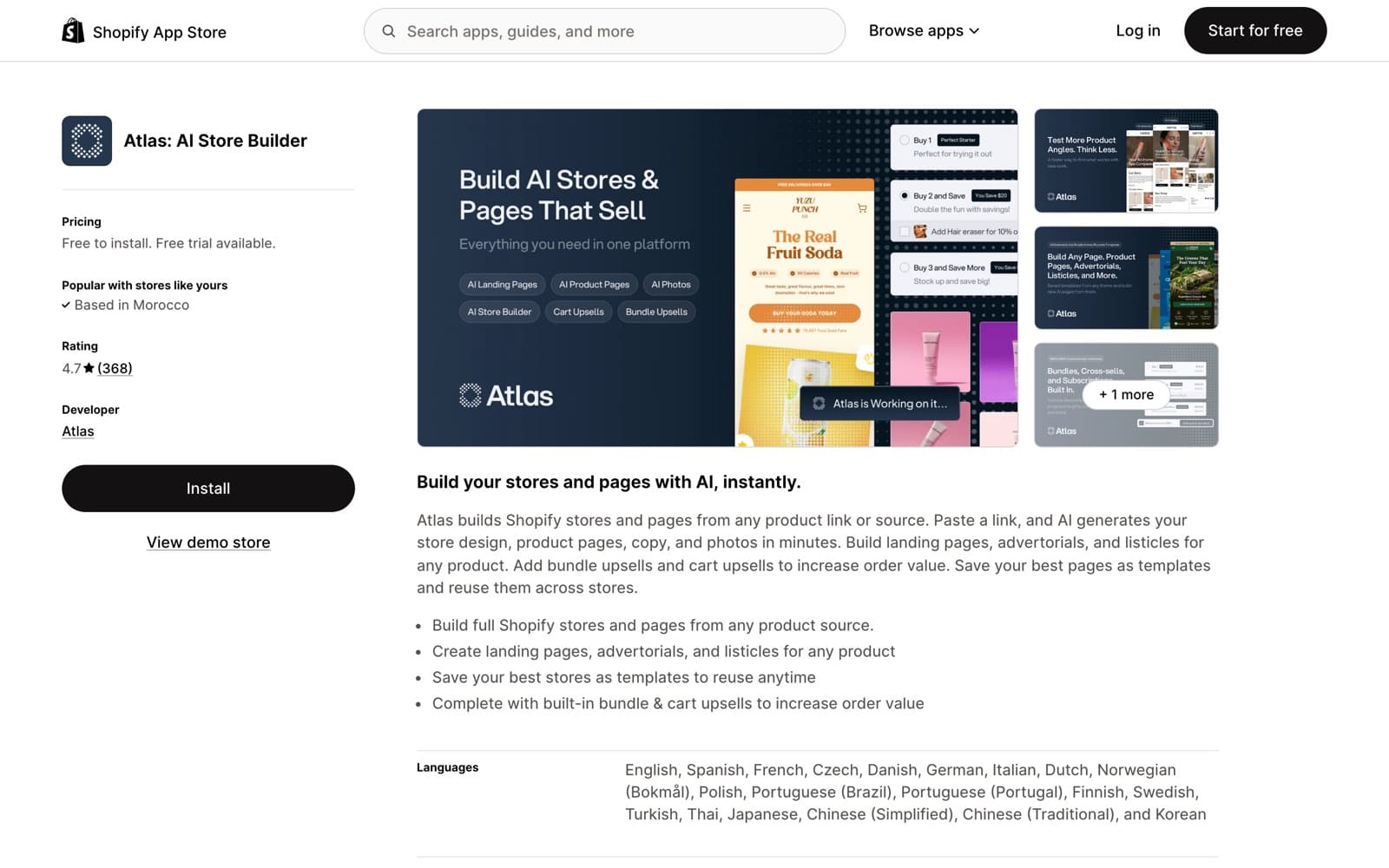
Atlas is a Shopify app that generates a store from a product link. As described in third-party comparisons published in early 2026, you paste a product URL, Atlas imports the product, writes the copy, and assembles a storefront using its own Atlas theme, which ships with about 35 customizable sections. Everything lands inside the native Shopify theme editor, so you customize with tools you already know.
The feature set around that core is genuinely useful for new stores: built-in bundle offers, a cart drawer with upsells, and AI product photos on paid plans. Pricing, as described in the same third-party comparisons, runs from a free plan with 50 monthly credits (a single product generation costs 10 credits) to Basic at 29 dollars per month and Premium at 99 dollars per month, plus an optional Atlas Bolt theme sold for 249 dollars one time. Confirm current numbers on Atlas's own listing before subscribing, since plans in this category change often.
What EcomWize actually does
EcomWize is an AI page builder, not a store generator and not a theme. You describe a product or paste its details, and an AI agent plans the page, picks sections from a library of 80+ conversion-optimized layouts, writes the copy, and applies your brand style, in about 60 seconds. New sections ship monthly. The output is native Shopify Liquid: no runtime scripts, no rendering layer, and pages keep working if you ever cancel.
Because sections are plain Liquid, they drop into any theme through the regular Shopify editor. EcomWize never asks you to switch themes. It also generates pages in any language, produces AI images including Scenes (reusable, consistent AI photoshoots for one product), removes image backgrounds, and includes its own cart drawer with a rewards bar, Buy More and Save bundle tiers, and one-tap upsells on paid plans.
EcomWize vs Atlas at a glance (July 2026)
| EcomWize | Atlas | |
|---|---|---|
| Category | AI page builder for any theme | AI store generator with its own theme |
| Starting point | A prompt describing your product or angle | A product link |
| Section library | 80+ sections, new monthly | About 35 sections in the Atlas theme (third-party figure) |
| Theme requirement | Works with any theme, no switch needed | Output built on the Atlas theme |
| Output | Native Liquid sections, no runtime scripts | Native theme editor sections |
| Cart and offers | Cart drawer with rewards bar, bundle tiers, one-tap upsells on paid plans | Cart drawer upsells and bundles built in |
| AI images | Included, plus Scenes photoshoots and background removal | Paid plans only, per third-party comparisons |
| Entry pricing | Free (150 credits/mo); Starter $49/mo | Free (50 credits/mo); Basic $29/mo (third-party figures) |
| App Store rating | New listing | Check current listing |
EcomWize numbers come from its own pricing page as of July 2026. Atlas numbers are as described in third-party comparisons from February 2026 and should be confirmed on Atlas's listing.
The theme question: 35 sections of Atlas vs 80+ sections in your theme
The structural difference between the two tools is where the design lives. Atlas output is built on the Atlas theme. That buys speed at setup, but it means your store's look is drawn from one theme's roughly 35 sections. Competitors have criticized this directly: because every Atlas store starts from the same theme, they share the same design DNA and can look recognizably alike. Treat that as a competitor's framing, but the underlying constraint is real for any theme-based generator.
EcomWize inverts the model. Your theme stays exactly as it is, and generated pages are added to it as sections. The 80+ section library is styled by a brand system, either AI-generated from a description of your brand or picked from DTC presets, so two EcomWize stores selling similar products do not converge on one look. In paid acquisition, where ad platforms reward novel creative and buyers punish template fatigue, that matters more than it sounds.
A store generator answers the question 'how do I get a store?'. A page generator answers the question 'how do I convert the traffic I am paying for?'. Most stores outgrow the first question in a month and live with the second one forever.
Cart drawers, bundles, and upsells compared
Both tools bundle AOV features that would otherwise cost a separate app subscription. Atlas ships cart-drawer upsells and bundles inside its theme, per third-party comparisons. EcomWize ships a cart drawer with a rewards progress bar, Buy More and Save quantity tiers, and one-tap upsells on paid plans, and because these are native features rather than script injections, they do not slow the storefront down.
The practical difference is portability. Atlas's offers live inside the Atlas theme. EcomWize's offers travel with your pages into whatever theme you run, which means you can adopt them without re-platforming your storefront design.
Credit models: what a month of building actually costs
Both products meter AI with credits, but the meters point at different things. Atlas's free plan includes 50 credits per month and one product generation costs 10 credits, per third-party comparisons, so the free tier covers about five store generations. Paid plans are Basic at 29 dollars and Premium at 99 dollars per month.
EcomWize credits meter AI actions only: page generation, copy rewriting, AI images. Manual editing is always free, so a generated page can be tweaked forever without spending anything. The free plan includes 150 credits per month. Starter is 49 dollars per month with 1,000 credits, Pro is 79 dollars with 5,000 credits plus unlimited publishing and stores, and Enterprise is 199 dollars with 20,000 credits. Annual billing drops those to 39, 63, and 159 dollars per month respectively, as of July 2026.

When Atlas is the right call
Atlas earns its place when the job is a fast store shell inside the Shopify ecosystem. A first-time dropshipper testing a product idea gets real value from pasting a link and receiving a working storefront the same day, with copy, bundles, and a cart drawer already wired up. Staying inside the native theme editor also means no new editor to learn and no proprietary rendering layer to worry about.
The honest caveat is what happens after the shell exists. Winning products need per-angle landing pages, advertorials, and listicles, and a theme's section set is not built for that volume of page-level variation. That is the point where stores typically add a page builder anyway.
Bottom line
Atlas and EcomWize overlap less than their AI branding suggests. Atlas compresses store setup; EcomWize compresses page production. If you are pre-store, Atlas gets you to a storefront fast, with the tradeoff that your design lives inside its theme. If you are post-store and buying traffic, EcomWize gives you prompt-to-page in about 60 seconds, 80+ sections in your own theme, and native Liquid output that keeps working whatever you do with your subscription. Plenty of operators will use a generator once and a page builder every week after that.
Frequently asked questions
What is the difference between EcomWize and Atlas?
Atlas is an AI store generator: it builds a full Shopify store from a product link using its own theme with about 35 sections, per third-party comparisons. EcomWize is an AI page builder: it generates individual landing pages, advertorials, and product pages as native Liquid sections that work inside any theme.
Does Atlas require you to use its own theme?
As described in third-party comparisons from early 2026, Atlas assembles stores on its own Atlas theme inside the native Shopify editor. EcomWize does not ship a theme at all; its sections drop into whatever theme your store already runs.
Do Atlas stores all look the same?
Competing tools have claimed Atlas stores share the same design DNA because they start from one theme. Treat that as competitor framing, but any theme-based generator faces the constraint. EcomWize pages draw on 80+ sections plus a per-store brand style system, so output varies more between stores.
How do EcomWize and Atlas credits compare?
Per third-party comparisons, Atlas's free plan includes 50 credits per month and one product generation costs 10 credits, with paid plans at 29 and 99 dollars. EcomWize includes 150 free credits per month, and paid plans run 49 to 199 dollars monthly with 1,000 to 20,000 credits. EcomWize credits only meter AI actions; manual editing is free.
Which is better for dropshipping product testing?
Atlas is faster to a first store shell from a product link. EcomWize is faster at producing distinct landing pages per ad angle once you are driving traffic, which is where most testing budgets are actually decided.
Can you use EcomWize and Atlas together?
Technically yes. You could generate a store shell with Atlas and add EcomWize landing pages on top, since EcomWize sections work in any theme, including Atlas's. Most stores end up needing the page layer either way.